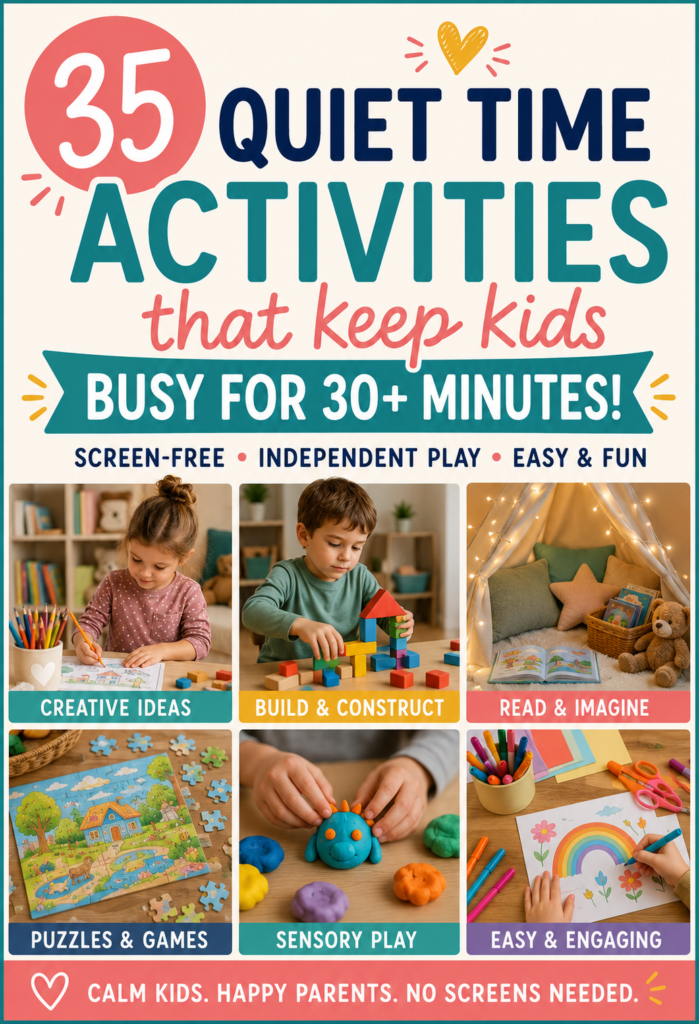

35 Quiet Time Activities That Keep Kids Busy for 30+ Minutes
If you’ve ever set up a quiet time activity only to hear „I’m done!“ five minutes later, you’re not alone.
Many quiet time ideas sound great in theory but fail to hold a child’s attention for very long. The secret isn’t finding complicated activities—it’s choosing open-ended activities that encourage creativity, problem-solving, and independent play.
Whether you’re working from home, caring for younger siblings, or simply need a little downtime, these quiet time activities can help keep kids happily engaged without screens.
What Makes a Good Quiet Time Activity?
The best quiet time activities share a few important qualities:
- They can be done independently.
- They don’t require constant adult supervision.
- They encourage creativity rather than following strict instructions.
- They can be extended and adapted by the child.
- They are relatively quiet and low-mess.
Here are 35 ideas that parents consistently find successful.
Creative Quiet Time Activities
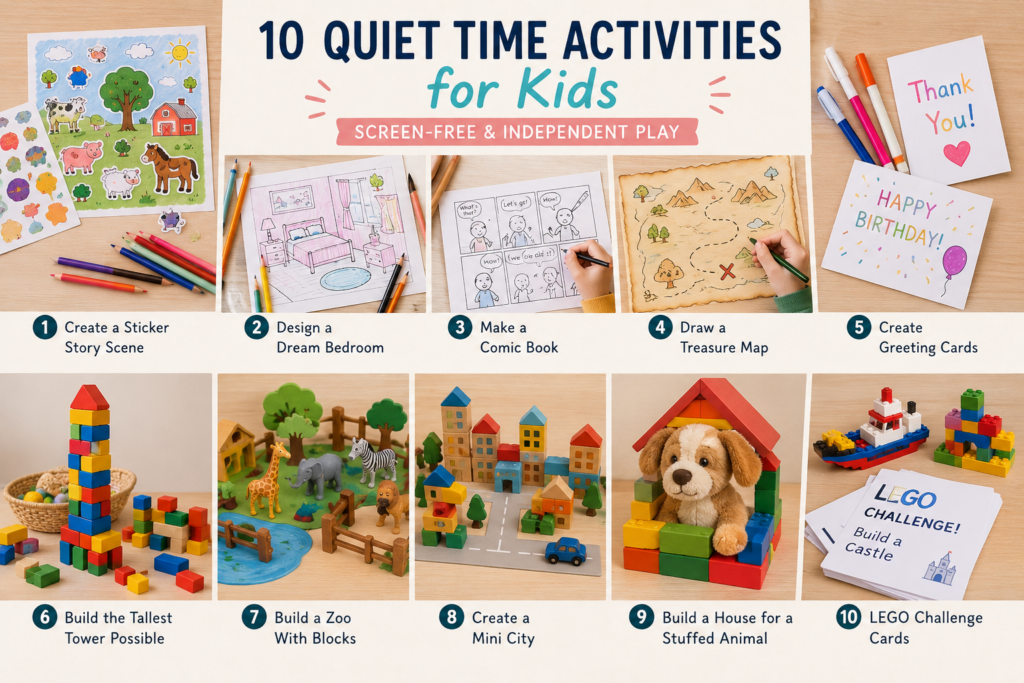
1. Create a Sticker Story Scene
Instead of simply decorating paper with stickers, challenge your child to create an entire story world. They might design a zoo, a fairy village, or a dinosaur park. Once the stickers are placed, they can add roads, buildings, and characters with crayons.
Best for: Ages 3–8
Quiet Time Potential: 20–40 minutes
2. Design a Dream Bedroom
Give children blank paper and ask them to draw their perfect bedroom. Encourage them to think about furniture, decorations, secret reading corners, and fun features.
Best for: Ages 5–10
Quiet Time Potential: 30+ minutes
3. Make a Comic Book
Kids can fold paper into a simple booklet and create their own comic strip. They can invent characters, write dialogue, and illustrate adventures.
Best for: Ages 6–10
Quiet Time Potential: 30–60 minutes
4. Draw a Treasure Map
Children love creating secret islands, hidden caves, and treasure routes. Once the map is finished, they can add clues and landmarks.
Best for: Ages 4–9
Quiet Time Potential: 20–45 minutes
5. Create Greeting Cards
Whether it’s for grandparents, friends, or neighbors, handmade cards combine drawing, writing, and creativity.
Best for: Ages 4–10
Quiet Time Potential: 20–30 minutes
Building Activities That Last
6. Build the Tallest Tower Possible
A simple challenge often keeps children engaged longer than free play. Encourage them to redesign and improve their structure multiple times.
Best for: Ages 4–10
Quiet Time Potential: 30–60 minutes
7. Build a Zoo With Blocks
Challenge your child to create animal habitats, visitor paths, feeding stations, and playgrounds using blocks or building bricks.
Best for: Ages 4–9
Quiet Time Potential: 45+ minutes
8. Create a Mini City
Roads, houses, parks, schools, and shops can all be built using blocks, cardboard, or magnetic tiles.
Best for: Ages 5–10
Quiet Time Potential: 30–60 minutes
9. Build a House for a Stuffed Animal
Children often spend far more time designing and decorating than actually building.
Best for: Ages 3–8
Quiet Time Potential: 30+ minutes
10. LEGO Challenge Cards
Write simple prompts such as „Build a spaceship“ or „Build a castle with a drawbridge.“
Best for: Ages 5–10
Quiet Time Potential: 30–60 minutes
Quiet Reading and Literacy Activities
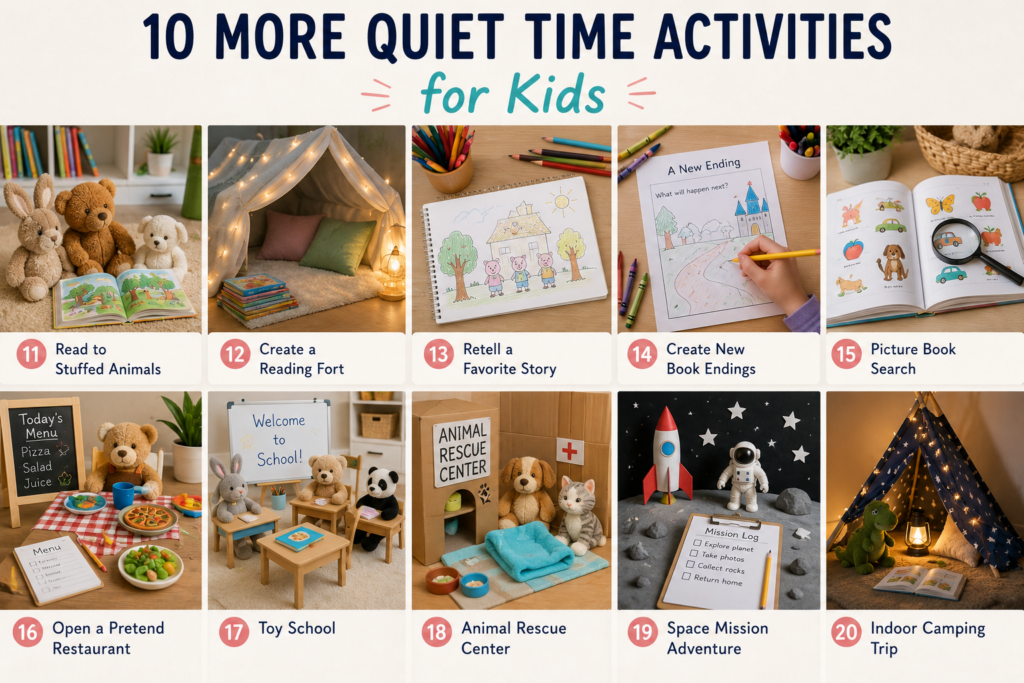
11. Read to Stuffed Animals
Children enjoy acting as the teacher and reading aloud to an audience of favorite toys.
Best for: Ages 3–8
Quiet Time Potential: 20–30 minutes
12. Create a Reading Fort
A blanket, a few pillows, and a stack of books can turn reading into an adventure.
13. Retell a Favorite Story
After reading, children can draw scenes or explain the story in their own words.
14. Create New Book Endings
Ask your child how the story would change if the ending were different.
15. Picture Book Search
Challenge them to find specific colors, animals, letters, or objects throughout a book.
Imaginative Play Activities
16. Open a Pretend Restaurant
Kids can create menus, take imaginary orders, and serve stuffed animals.
17. Toy School
Stuffed animals become students while your child becomes the teacher.
18. Animal Rescue Center
Toy animals need homes, food, and medical care.
19. Space Mission Adventure
Children can imagine exploring new planets and recording discoveries.
20. Indoor Camping Trip
A blanket fort becomes a campsite complete with stories and pretend adventures.
Puzzle and Brain Activities
21. Jigsaw Puzzles
Choose age-appropriate puzzles that provide a challenge without causing frustration.
22. Maze Books
Mazes encourage concentration and independent problem-solving.
23. Tangram Challenges
Kids can recreate animals, vehicles, and shapes using simple geometric pieces.
24. Memory Matching Games
Children can play independently by timing themselves or trying to beat previous scores.
25. Connect-the-Dots Books
These activities combine counting, concentration, and fine motor skills.
Fine Motor Quiet Time Activities
26. Bead Stringing
A simple activity that strengthens hand-eye coordination and focus.
27. Pipe Cleaner Creations
Children can make animals, flowers, glasses, or abstract sculptures.
28. Pom-Pom Sorting
Sort by color, size, or create patterns.
29. Play Dough Challenge Cards
Ask children to create animals, food items, or letters from play dough.
30. Craft Stick Building
Kids can build houses, bridges, and geometric shapes.
Quiet Time Activities for Older Kids
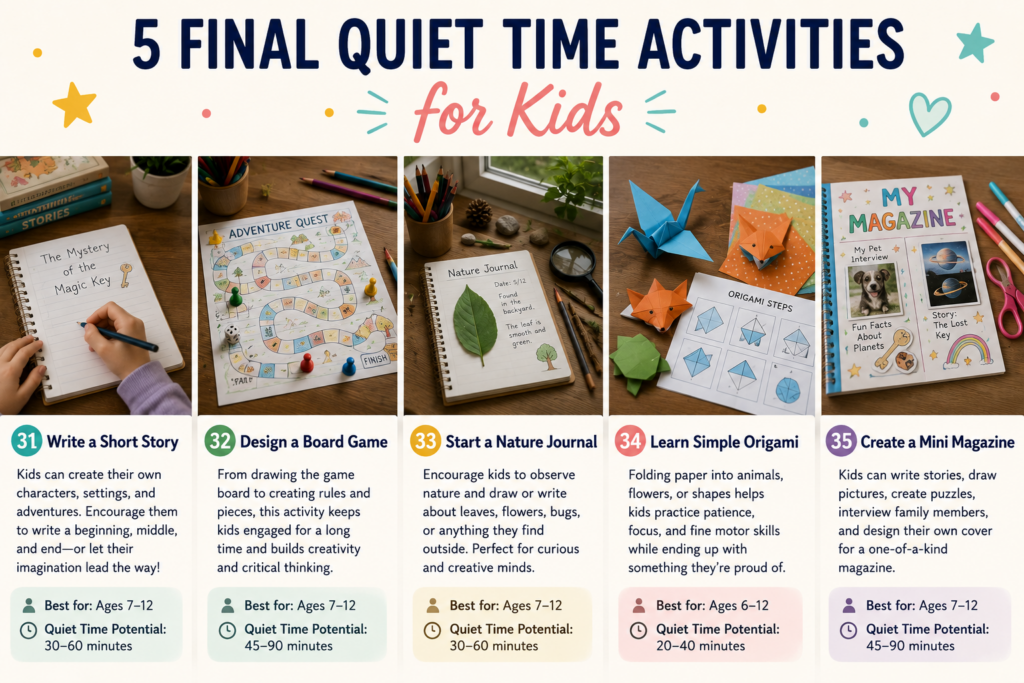
31. Write a Short Story
Older children often enjoy creating characters and adventures of their own.
32. Design a Board Game
Creating the rules can be just as engaging as playing.
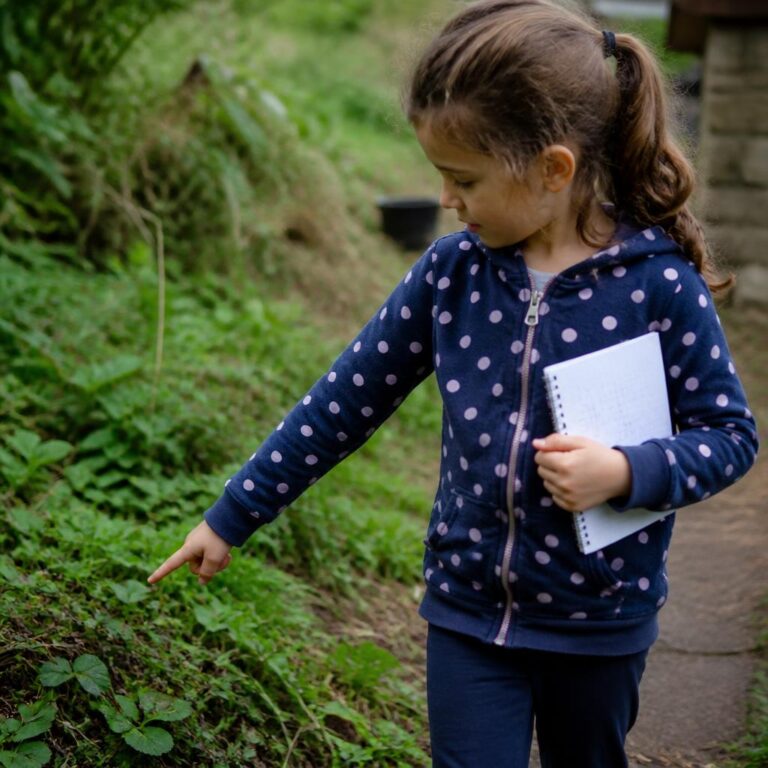
33. Start a Nature Journal
Kids can draw leaves, flowers, insects, or observations from the backyard.
34. Learn Simple Origami
Folding paper into animals and shapes encourages patience and focus.
35. Create a Mini Magazine
Children can combine writing, drawing, puzzles, and stories into their own publication.
Tips for Longer Quiet Time Success
Even the best activities work better when presented strategically.
- Rotate activities every week.
- Save certain toys exclusively for quiet time.
- Offer two or three choices rather than unlimited options.
- Use a visual timer so children know when quiet time ends.
- Start with shorter sessions and gradually increase the duration.
Most importantly, don’t worry if your child occasionally says they’re bored. Boredom often leads to creativity, problem-solving, and the kind of independent play that quiet time is designed to encourage.
Final Thoughts
Quiet time doesn’t have to involve screens or constant entertainment. With the right activities, children can stay engaged, build valuable skills, and learn to enjoy independent play.
Try a few of these ideas, discover which ones your child loves most, and create a quiet time routine that works for your family.