
Early Math Skills for Preschoolers: The Complete Guide for Ages 3–5
Discover the essential early math skills every preschooler should develop before kindergarten, along with fun, hands-on activities you can easily do at home.
Early math is much more than counting
When many parents hear the word math, they immediately think about numbers, counting to ten, or solving simple addition problems.
But preschool math is much more than that.
Long before children can write numbers or understand equations, they’re already developing mathematical thinking through everyday experiences. Every time your child sorts toys by color, notices that one tower is taller than another, or recognizes a circle in a picture book, they’re building important math skills.
The wonderful thing about early math is that it doesn’t require expensive toys or complicated lessons. Children learn best through play, conversations, and exploring the world around them.
In this guide, you’ll discover:
- the most important preschool math skills
- why these skills matter
- fun activities you can do at home
- common mistakes to avoid
- easy ways to include math in everyday life
Whether your child is three, four, or getting ready for kindergarten, these activities will help them build confidence while making learning fun.
Why Are Early Math Skills Important?
Research consistently shows that early math skills play an important role in children’s overall development.
Learning math isn’t simply about memorizing numbers.
It helps children develop:
- logical thinking
- problem-solving abilities
- critical thinking
- memory
- attention
- reasoning skills
- confidence when learning new concepts
Children who have positive experiences with math during the preschool years often feel more confident when they begin kindergarten.
Even simple activities like sorting socks or building block towers teach valuable mathematical concepts.
Most importantly, preschool math should always feel like play—not like school.
Essential Preschool Math Skills
Before children begin learning addition or subtraction, they first need to master a variety of foundational skills.
These include:
| Skill | Why It Matters |
|---|---|
| Counting | Builds number sense |
| Number Recognition | Connects written numbers to quantities |
| Sorting & Classifying | Develops logical thinking |
| Shapes | Builds spatial awareness |
| Patterns | Strengthens prediction and reasoning |
| Comparing | Introduces measurement concepts |
| Measurement | Encourages observation |
| Problem Solving | Develops flexible thinking |
Let’s look at each skill more closely.
1. Counting
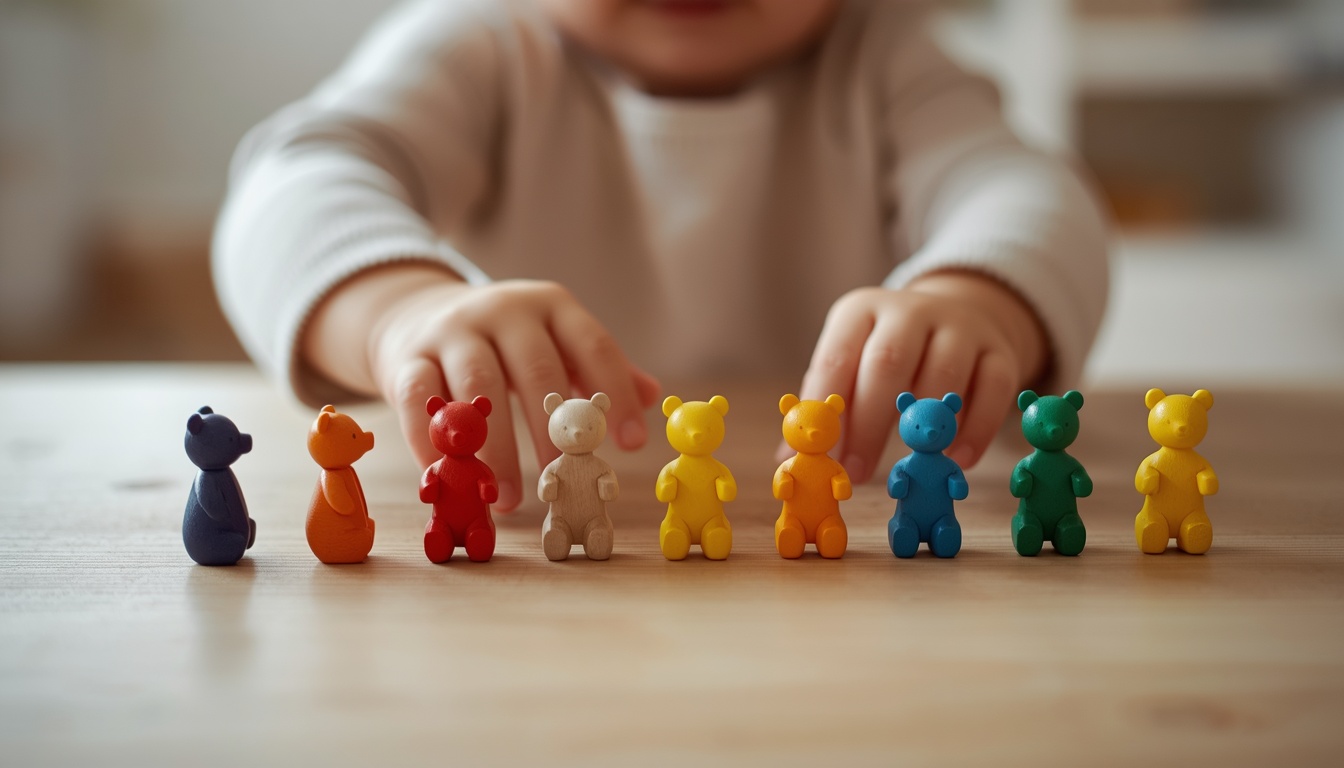
Counting is often the first math skill parents think about, but it’s also one of the most misunderstood.
Many preschoolers can recite:
„One, two, three, four, five…“
without actually understanding what those numbers represent.
True counting means matching one number to one object.
For example, if your child counts five apples, they should touch each apple only once while saying one number.
This concept is called one-to-one correspondence, and it’s one of the most important early math skills.
Counting Milestones
Around age 3, many children can:
- count to five
- count a few objects accurately
- begin understanding „more“ and „less“
Around age 4, children often:
- count to ten or beyond
- count larger groups of objects
- understand that the last number counted tells how many objects there are
By age 5, many children can:
- count to twenty or higher
- count backwards from ten
- begin simple counting games
Remember that every child develops at their own pace.
Fun Counting Activities
Count During Daily Routines
Math doesn’t have to happen at a table.
Count together while:
- climbing stairs
- setting the table
- putting groceries away
- picking flowers
- collecting leaves
- feeding a pet
Children learn best when counting has a real purpose.
Teddy Bear Picnic
Materials:
- stuffed animal
- small crackers or pom-poms
Ask your child:
„Can you feed Teddy five snacks?“
Then count together as each snack is placed in front of the teddy bear.
Make mistakes on purpose occasionally.
„Oh no! I gave Teddy six! Can you help me fix it?“
Children love correcting adults.
Number Hop
Write numbers 1–10 on paper.
Place them on the floor.
Call out a number.
Your child jumps onto the correct number.
This combines movement with learning.
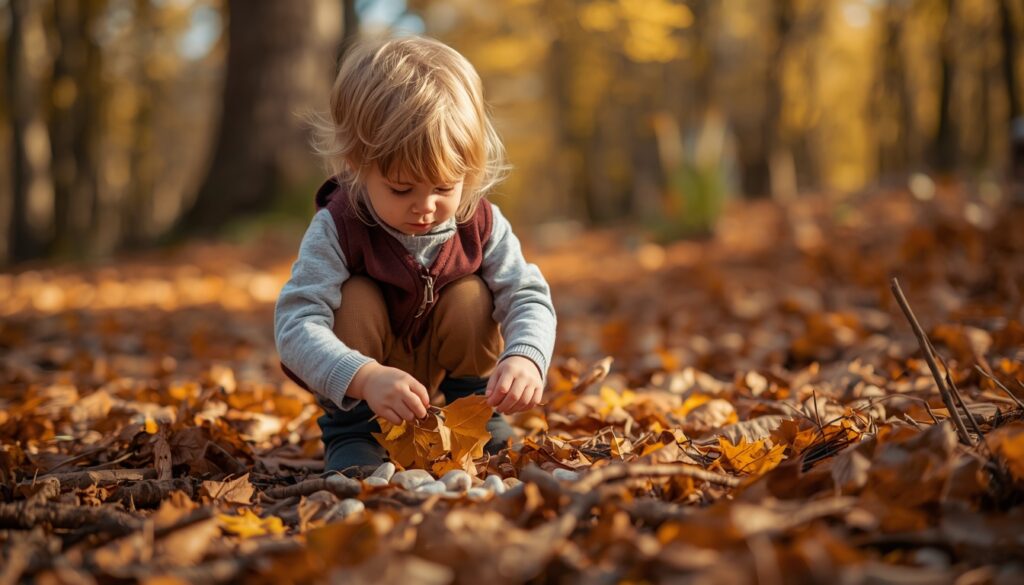
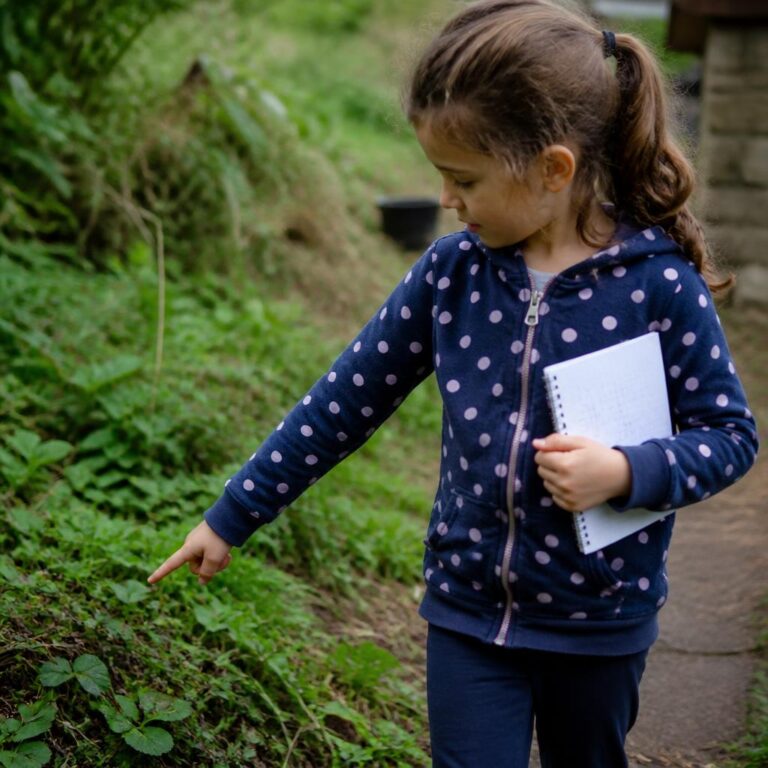
Nature Counting Walk
Go outside together and collect:
- five leaves
- three sticks
- two flowers
- eight stones
- one feather
After returning home, sort and count everything together.
Roll and Count
You’ll need:
- one die
- small blocks or pom-poms
Roll the die.
Your child counts out the matching number of objects.
Repeat several times.
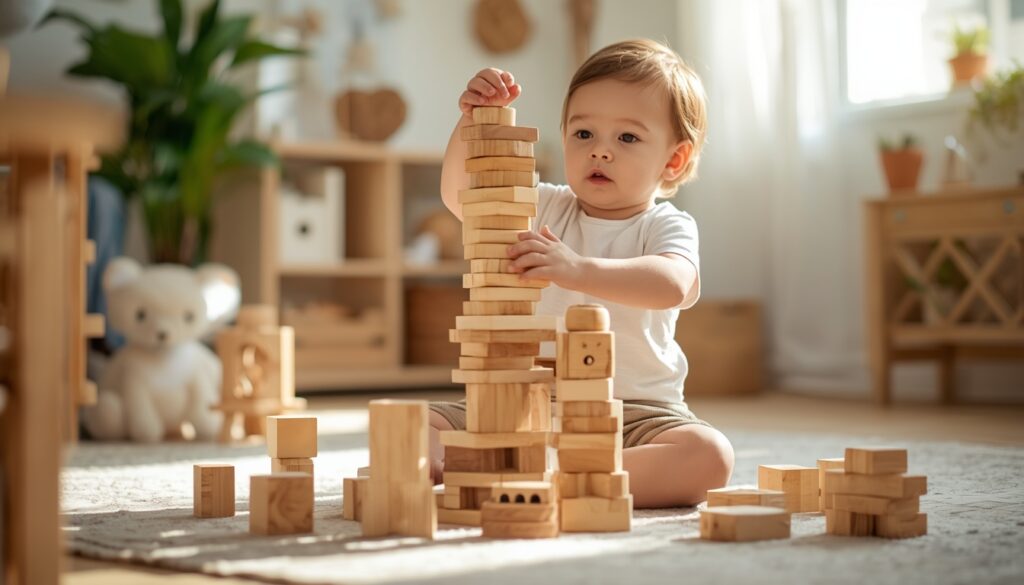
Build a Tower
Roll a die.
Build a block tower with that many blocks.
Compare towers after several rounds.
Which tower is taller?
Which one is shorter?
2. Number Recognition
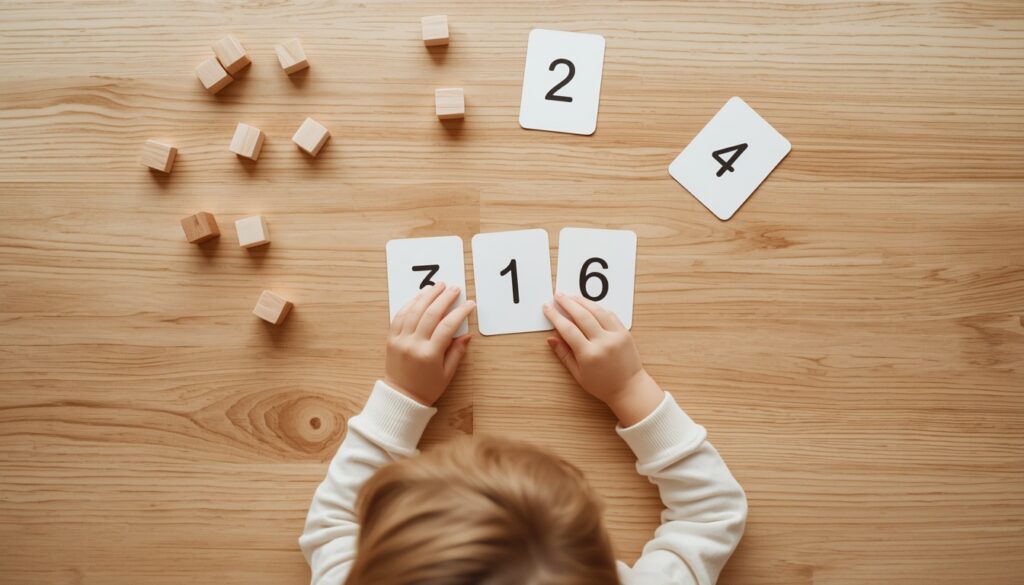
Once children begin understanding quantities, they can slowly connect those quantities to written numbers.
Recognizing numbers is different from counting.
A child may count to ten perfectly but still not recognize the written number 6.
That’s perfectly normal.
Children usually learn number recognition gradually through games and repeated exposure rather than memorization.
Typical Number Recognition Milestones
Many 3-year-olds begin recognizing a few familiar numbers, especially their age.
By age four, children often recognize most numbers from 1–10.
By age five, many children recognize numbers up to 20 or higher.
Again, every child develops differently.
The goal isn’t speed—it’s confidence.
Number Recognition Activities
Number Hunt
Write numbers 1–10 on sticky notes.
Hide them around the room.
Ask questions like:
„Can you find number 4?“
or
„Where is number 8 hiding?“
Turn it into a treasure hunt.
Parking Lot Game
Draw parking spaces numbered 1–10.
Use toy cars.
Each car parks in the matching numbered space.
If your child enjoys vehicles, this activity can easily keep them engaged for a long time.
Build Numbers with Playdough
Roll small pieces of playdough into long „snakes.“
Shape them into numbers.
Children remember concepts much better when they use their hands.
Number Match
Write numbers on index cards.
Place the same numbers on clothespins.
Your child clips the correct clothespin onto each matching card.
This activity also strengthens fine motor skills.
Number Books
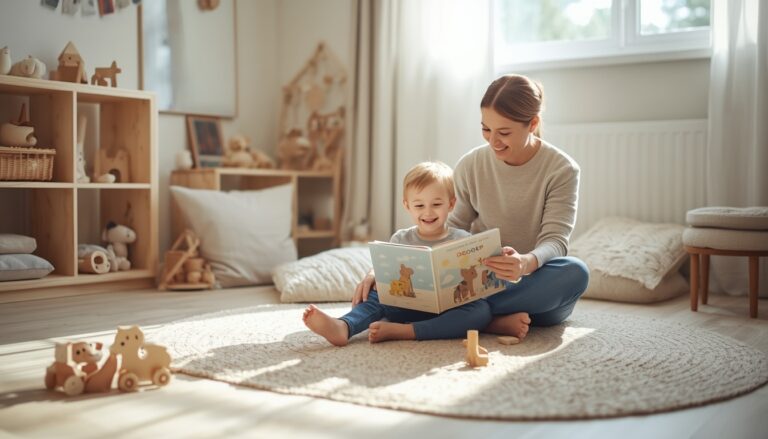
As you read together, invite your child to spot numbers in the illustrations or on the pages.
You can also look for numbers during everyday outings:
- house numbers
- price tags
- calendars
- elevator buttons
- buses
The more naturally children see numbers, the more familiar they become.
3. Shapes
Before children can write numbers or solve math problems, they first need to understand the shapes they see all around them.
Learning about shapes helps preschoolers develop spatial awareness, improve visual perception, and recognize patterns. These skills are essential for later learning, including reading, writing, and geometry.
Instead of asking children to memorize shape names, encourage them to discover shapes in everyday life.
Basic Shapes Preschoolers Should Learn
By the time children enter kindergarten, they are often familiar with:
- Circle
- Square
- Rectangle
- Triangle
- Oval
- Star
- Heart
- Diamond (Rhombus)
Remember that children don’t need to recognize every shape perfectly. The goal is to explore them through play.
Shape Activities
Shape Hunt Around the House
Challenge your child to find objects shaped like:
- Circle → plate, clock, orange
- Square → sticky note
- Rectangle → book, door
- Triangle → slice of pizza
Turn it into a game by setting a timer.
„Can you find five circles before the timer rings?“
Build Shape Pictures
Cut simple paper shapes.
Invite your child to create:
- a house
- a rocket
- a flower
- a robot
- an animal
Ask questions such as:
„What shape did you use for the roof?“
„Can you make the tree taller?“
Shape Sorting
Mix different paper shapes together.
Sort them by:
- shape
- size
- color
Then count how many are in each group.
Shape Walk Outside
Go for a neighborhood walk and look for shapes everywhere.
Examples:
- rectangular windows
- circular wheels
- triangular roofs
- square paving stones
Children love discovering that math exists outside worksheets.
Playdough Shapes
Roll playdough into long snakes.
Use them to create different shapes.
Ask:
„Which shape has three sides?“
„Which one can roll?“
4. Sorting and Classifying
Sorting is one of the earliest math skills children develop.
When children notice similarities and differences, they’re learning how to organize information—a skill they’ll use throughout school.
Sorting also encourages observation and critical thinking.
Sorting Activities
Laundry Helper
Ask your child to sort laundry by:
- color
- owner
- size
- clothing type
This simple household chore becomes an excellent learning opportunity.
Nature Sorting
Collect natural materials such as:
- leaves
- pinecones
- stones
- flowers
- sticks
Sort them by:
- color
- size
- texture
- shape
Ask questions like:
„Which group has the most?“
„Which pile is the smallest?“
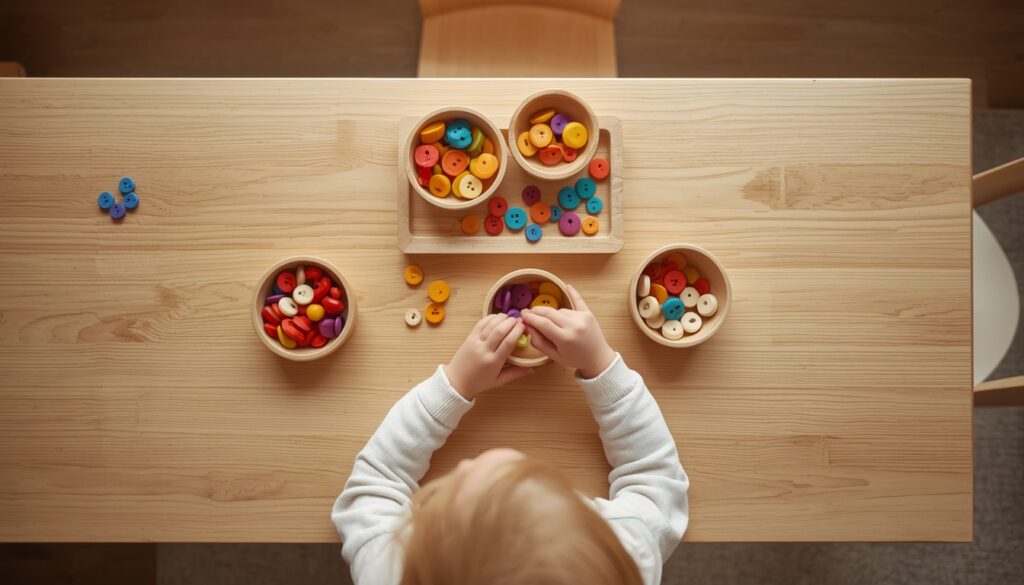
Button Sorting
Use a collection of buttons.
Sort by:
- color
- number of holes
- size
- shape
This activity also strengthens vocabulary.
Animal Sorting
Use toy animals.
Create groups such as:
- farm animals
- wild animals
- animals that fly
- animals that swim
This combines science with math.
Kitchen Sorting
Invite your child to organize:
- spoons
- forks
- cups
- lids
- containers
Children often enjoy helping with real household tasks.
5. Patterns
Patterns are everywhere.
Children see them in clothing, music, nature, architecture, and everyday routines.
Recognizing and creating patterns helps children develop prediction skills, logical thinking, and early algebraic reasoning.
Fortunately, patterns are also incredibly fun to explore.
Pattern Activities
Bead Patterns
Thread beads onto a string.
Create patterns such as:
Red – Blue – Red – Blue
Yellow – Green – Yellow – Green
Then ask your child to continue the sequence.
Snack Patterns
Use small snacks like:
- grapes
- crackers
- cereal
- raisins
Create patterns before enjoying the snack together.
Learning has never tasted so good!
Nature Patterns
Arrange natural objects.
Examples:
Leaf – Stick – Leaf – Stick
Stone – Leaf – Stone – Leaf
Flower – Flower – Leaf – Flower – Flower – ?
Ask:
„What comes next?“
Clap Patterns
Create movement patterns.
Examples:
Clap – Stomp – Clap – Stomp
Jump – Jump – Spin
Children often learn best when their whole body is involved.
LEGO Patterns
Build color patterns using LEGO bricks.
Try making them increasingly challenging as your child gains confidence.
6. Comparing and Measuring
Children naturally compare objects every day.
They notice:
„This one is bigger.“
„My tower is taller.“
„This teddy is heavier.“
These observations build the foundation for measurement and estimation.
There’s no need to introduce rulers or measuring tapes right away.
Simple conversations are enough.
Comparing Activities
Build and Compare Towers
Build two towers using blocks.
Ask:
- Which tower is taller?
- Which one is shorter?
- Can you build one that’s exactly the same height?
Heavy or Light?
Collect household objects.
Examples:
- apple
- spoon
- book
- toy car
- feather
Before lifting them, ask:
„Which one do you think is heavier?“
Then test your predictions together.
Long or Short?
Gather different objects such as:
- pencils
- ribbons
- sticks
- straws
Arrange them from shortest to longest.
Fill the Cups
Provide several containers of different sizes.
Use water, rice, or dry beans.
Ask:
„Which cup holds the most?“
Children love pouring and experimenting.
Who Has More?
Place two groups of objects on the table.
For example:
5 buttons
8 buttons
Ask:
„Which group has more?“
„How do you know?“
Avoid correcting immediately.
Instead, encourage your child to explain their thinking.
Everyday Math Opportunities
One of the easiest ways to build early math skills is to include them naturally throughout the day.
Children often learn more from everyday conversations than from structured lessons.
Here are a few ideas.
In the Kitchen
- Count blueberries while baking.
- Measure flour.
- Compare the sizes of bowls.
- Cut sandwiches into different shapes.
- Sort fruit by color.
At the Grocery Store
- Count apples into the bag.
- Find number 5 on price tags.
- Compare which cereal box is taller.
- Look for circles, rectangles, and squares.
Outside
- Count birds.
- Compare sticks.
- Find patterns in flowers.
- Measure shadows.
- Collect leaves and sort them.
During Play
- Build the tallest tower.
- Count puzzle pieces.
- Organize toy animals.
- Make patterns with blocks.
- Compare stuffed animals by size.
The best math lessons often happen without children even realizing they’re learning.
Preschool Math Milestones by Age
Every child develops at their own pace, and these milestones should be used as a general guide rather than a checklist. Some children master certain skills earlier, while others simply need a little more time and practice.
The goal isn’t perfection—it’s building confidence through playful experiences.
| Age | Typical Early Math Skills |
|---|---|
| 3 Years | Counts a few objects, recognizes simple shapes, sorts by color, understands „more“ and „less.“ |
| 4 Years | Counts to 10 or higher, recognizes numbers 1–10, creates simple patterns, compares objects by size, identifies common shapes. |
| 5 Years | Counts beyond 20, recognizes many numbers, compares quantities, measures informally, solves simple everyday math problems. |
Remember that preschool is about exploration, not testing.
Signs Your Child May Benefit From More Math Practice
Every child learns differently. Some children naturally enjoy counting and puzzles, while others need more hands-on experiences before concepts begin to click.
You may want to provide extra opportunities for practice if your child:
- avoids counting objects
- has difficulty matching one object to one number
- struggles to recognize basic shapes
- cannot sort objects by color or size
- becomes frustrated during simple counting games
- has trouble noticing simple patterns
This doesn’t necessarily mean something is wrong. Many children simply learn best through movement, play, and repeated everyday experiences.
If you have concerns about your child’s overall development, speak with your pediatrician or early childhood educator.
Common Mistakes Parents Make
1. Focusing Only on Counting
Many parents believe counting is the only preschool math skill.
In reality, children also need to explore:
- sorting
- comparing
- measuring
- patterns
- shapes
- problem solving
All of these skills build mathematical thinking.
2. Using Worksheets Too Early
Worksheets certainly have their place, but they should never replace hands-on learning.
Young children learn best by touching, moving, building, exploring, and talking about what they discover.
If a child isn’t ready for pencil-and-paper activities, that’s perfectly normal.
3. Correcting Every Mistake
Mistakes are an important part of learning.
Instead of saying,
„No, that’s wrong.“
Try asking,
„Let’s count together.“
or
„Can you show me how you figured that out?“
This encourages confidence and critical thinking.
4. Rushing Through Skills
Children don’t need to learn everything at once.
Mastering one concept well is much more valuable than quickly introducing many different topics.
Celebrate small successes and keep learning fun.
25 Easy Preschool Math Activities
Looking for simple ways to practice math every day? Try these quick ideas using materials you already have at home.
- Count the steps as you walk upstairs.
- Sort socks by color.
- Count blueberries before snack time.
- Build towers and compare their height.
- Find circles around the house.
- Match lids to containers.
- Count toy cars.
- Sort LEGO bricks by color.
- Make a red-blue-red-blue pattern.
- Count birds outside the window.
- Measure ingredients while baking.
- Compare the sizes of leaves.
- Set the table together.
- Organize crayons by color.
- Count the buttons on a shirt.
- Find numbers on mailboxes during a walk.
- Build numbers with playdough.
- Sort toy animals into groups.
- Roll a die and count blocks.
- Compare which stuffed animal is bigger.
- Arrange pencils from shortest to longest.
- Count flower petals.
- Look for shapes on road signs.
- Create a simple obstacle course and count each station.
- Read a counting book together.
Little moments like these can make a big difference over time.
Frequently Asked Questions
What math should a 3-year-old know?
Most three-year-olds are beginning to:
- count a few objects
- recognize simple shapes
- sort objects by color or size
- understand basic concepts like „more“ and „less“
Children at this age learn best through play and everyday routines.
What math should a 4-year-old know?
Many four-year-olds can:
- count to ten or higher
- recognize numbers 1–10
- identify common shapes
- create simple patterns
- compare objects by size
Remember that every child develops at a different pace.
What math should a 5-year-old know before kindergarten?
Many children entering kindergarten can:
- count to 20 or beyond
- recognize many numbers
- compare quantities
- solve simple everyday math problems
- identify and describe common shapes
- continue simple patterns
These skills provide a strong foundation for future learning.
Do preschoolers need worksheets?
Worksheets can be a useful supplement, but they should never replace hands-on learning.
Young children learn best through:
- play
- conversation
- movement
- exploration
- everyday experiences
Think of worksheets as one small tool in a much larger learning toolbox.
How much math should my preschooler practice each day?
There is no need for long lessons.
Even 10–15 minutes of playful math activities each day can make a meaningful difference.
The best learning often happens naturally while cooking, shopping, reading, or playing together.
Final Thoughts
Early math isn’t about creating little mathematicians.
It’s about helping children develop curiosity, confidence, and problem-solving skills through meaningful everyday experiences.
Whether your child is counting toy cars, sorting leaves, comparing towers, or looking for shapes on a neighborhood walk, they are building important skills that will support them throughout their school years.
Remember, the goal isn’t to teach preschoolers advanced math.
The goal is to help them enjoy learning.
When math feels like play, children are far more likely to stay curious, ask questions, and develop the confidence they’ll carry into kindergarten and beyond.
So the next time you bake cookies, sort laundry, or build with blocks, know that you’re doing much more than spending time together—you’re helping your child build a strong foundation for lifelong learning.